
This special exhibition in Nice, France, invites us into the spectacular and colourful world of street artists. Dancers, storytellers, musicians, and acrobats, are all depicted as free spirits in a timeless world that traverses centuries. In the prints, these Japanese street performers transform the space into a stage and the everyday into a celebration, at a crossroads of the sacred, the popular, and the wondrous.
In Japan, street artists played an essential role in the transmission of stories, knowledge, and emotions to a public that was increasingly looking for entertainment. Their creativity continues to permeate Japanese culture today, from cinema and comics, to theatre and the public arts. This exhibition Saltimbanques au Japon (Street Performers/Circus Entertainers in Japan) invites us to explore this constellation of itinerant artists who entertained the Japanese during the Edo (1603-1868) and Meiji periods (1868-1912), through 70 prints from the collection of Jeanne-Yvonne and G Edard Borg.
Marginalised since ancient times, street performers occupy a unique place in the cultural and visual history of the country. During the Edo period (1603-1868), the ruling Tokugawa shoguns attempted to control public morals and provide personal security by creating entertainment districts in which prostitution was licensed. Jugglers, acrobats, tightrope walkers, animal trainers, illusionists were pushed into these areas. In the Tokugawa capital of Edo (modern-day Tokyo), the Yoshiwara district was the government-regulated pleasure quarter in which the courtesans conducted their business., and artisans traditionally performed in public squares, near shrines, and during seasonal festivals. Other cities such as Kyoto and Osaka also maintained entertainment areas, or pleasure quarters, for the public to frequent.
Since at least the Heian period (794-1185), street performers entertained the public with a variety of activities, including music, dance, acrobatics, juggling, and magic tricks, in exchange for a few coins with their performances having their origins in traditional dances and rituals stemming from Shinto and Buddhist beliefs. These practices are often grouped under the term misemono, which literally means ‘things that are shown’ and encompasses all sorts of curiosities and astonishing phenomena designed to arouse wonder and curiosity in the public, including the display of wild animals. It was not uncommon to encounter these entertainers during festive periods throughout the year, particularly at the New Year, where their role was to purify and ward off evil spirits in order to begin the year with auspicious beginnings. These traditions continue to this day, so it is not uncommon to stumble upon a lion dance or other acrobatic performances while travelling around the archipelago during festivals.
During the Edo period, the urban population was growing and popular entertainment experienced an unprecedented growth in the city. The public, eager for images and stories, became captivated by street performances, and ukiyo-e artists strived to capture this atmosphere, excitement, and latest fashions in their prints.
After more than 250 years of isolation, Japan was forced to finally open itself to the world in 1854. During the Meiji era, the rapid modernisation of the country’s cities, encouraged even more people to move to urban centres and facilitated the burgeoning middle classes. These urban classes helped support the evolution of popular entertainment in their thirst for diversion and amusements. Some prints from this period retain iconography inherited from the Edo period, while others incorporate new influences and look to this modern and transforming world for inspiration. In the newly opened port cities, such as Yokohama, Kobe, Nagasaki, Hakodate, and Niigata (the Treaty Ports), newly introduced Western circus performances captivated a population torn between curiosity and reserve.
At this time, the American Richard Risley Carlisle (1814-1874), known as ‘Professor Risley’ and his circus troupe arrived in Yokohama, where they performed for the public. He was an acrobat and adventurer, hailing from New Jersey in the US. In 1858, after training and performing across Europe, he formed his own circus troupe in London and set off to tour Oceania and Asia, performing in Hawaii in 1860, and in Sydney in September of the same year. By 1861, his troupe was in Singapore and had progressed to Shanghai in 1863, from where they set off for Japan and their well-received performances in Yokohama. The original troupe comprised 10 acrobatic performers and eight horses.
Risley’s arrival in Japan had opened doors to other circuses, such as that of the Frenchman Louis Soullier in 1871, whose equestrian acrobatics performed by female riders particularly astonished the Japanese public. But the troupe that most fascinated the inhabitants of the archipelago, even performing before Emperor Meiji, was the circus of the Italian Giuseppe Chiarini, which arrived in Tokyo in 1886. It was the first time the Meiji emperor had seen a circus and he rewarded Chiarini with $5,000 in gold. The circus went on to tour throughout Japan, bringing with it clowns and a large menagerie of exotic animals, including a lion and an elephant. Prints depicting these circus performers are on show in the exhibition.
Less well-known was the Australian Woodyear Circus, which performed in Japan in 1888, demonstrating Japan’s continuing fascination with circus performers. This fascination was to go both ways – Risley’s encounter with local travelling entertainers inspired him to take a group back with him to perform in the US. In this reciprocal exchange, Japanese street performers aroused the admiration of Western audiences, and they were even captured on early ciné reels.
Circus animals were also part of the main attractions. Japan has had a long fascination with wild animals and one animal that was often depicted is the monkey. Throughout history, and in many cultures, the monkey has embodied an ambivalent symbolism: it is both learned and comical. In Japan, during the Kamakura period (1185-1333), it was considered the messenger of the gods and the protector of horses, keeping them company in the stables. Due to its sacred and benevolent nature, it was displayed at the imperial court during the New Year, as part of the purification rites specific to this period. During the Edo period, in the late 17th and early 18th centuries, as samurai culture became established, the role of monkey training (sarumawashi) changed for a formal religious ritual into popular entertainment, relegated to the ranks of other street performers.
Other prints in the exhibition illustrate the great public displays of during the seasonal festivals in Japan. New Year, the changing seasons, the commemoration of the dead, and other religious festivals, are all occasions for celebration and a chance to give tributes to deities and ancestors. They also make wonderful subject matter for prints. Originally, festivals were held in two parts – the first called matsuri, a term still used today, was dedicated to the religious aspect of the festival and communion with the deity through prayers and ablutions. The second, called sairei, encompassed religious activities intended to entertain the deity and, more generally, the public.
And there is no better form of public entertainment to attract the crowds than acrobatics. This form of entertainment is believed to have arrived in Japan from China in the 7th century. Karuwaza is a general term covering what in the West would be called acrobatics – such as juggling, wire walking and balancing acts. Karu means light, or agile, waza is trick or business – and there is also a secondary meaning of ‘risky business’. During the Muromachi period (1392-1573) a form of acrobatics – largely wire walking and paper walking – called ‘spider dancing’ (kumomai) was sponsored by aristocrats and military leaders as a type of religious entertainment and incorporated into kabuki. When women (who were usually courtesans) were banned from performing in kabuki in the 17th century, these roles were taken over by young boys aged eleven to fifteen.
With growing urbanisation in the Edo period, these acrobats began to perform in cities and towns for the enjoyment of all classes of society. By the 15th century, various acrobatic, dance, and parade activities had taken precedence over the religious dimension of the great public festivals. Today, these celebrations continue to punctuate the daily life in Japan.
Another form of acrobatics features firefighters. In 1657, the Great Fire of Meireki, which claimed 100,000 lives, devastated 70% of the city of Edo. Built primarily of wood and bamboo, Edo was particularly vulnerable to fires, which were known as the ‘Flowers of Edo’. Nearly 2,000 fires broke out over two and a half centuries, 50 of them major. In this battle, firefighters played a vital role, perched on their ladders, watching for potential hotspots to protect the population. The Dezomeshiki, a ceremony traditionally held in early January to mark the start of the New Year, originated from the need to raise public awareness of fire risks. This festival features acrobatic displays, where firefighters, perched on 6-metre-high ladders (hashigo-nori), demonstrate their agility. There are also parades and demonstrations of brigade manoeuvres, processions of traditional costumes, depending on the region and era, as well as fireworks. Today, firefighters perpetuate this tradition, blending ancient gestures with modern practices. A print of firefighters performing at New Year by Hiroshige Utagawa III (1843-1894) is included in the exhibition.
Exotic animals were usually found at the fairground attractions on Ryogoku Bridge and in Asakusa in Edo, located in the capital’s most lively districts. Between 1770 and 1870, various animals were brought into the city, including a panther in 1860. An elephant had already been seen in Nagasaki in 1727, when a male and a female arrived from Cochin, India, to be exhibited in the city. More than a century later, in 1863, the elephant’s imposing stature and unusual trunk continued to amuse the Japanese crowds who came to see it in Edo. This appearance was widely documented in a print that year by such artists as Utagawa Yoshikazu (active 1850-70), Taguchi (Utagawa) Yoshimori (1830-1884), Yoshitoro Ichiryusai (1830-1866). It was widely believed that viewing these rare animals could cure a variety of ills, such as smallpox.
Circus troupes usually had animals performing tricks as part of their repertoire. Chiarini’s Circus had in their menagerie three tigers under the control of an animal trainer, as well as a lion and elephant, as can be seen in one of Yoshu Chikanobu’s prints of 1886. One celebrated feline, brought from the US and resembling a tiger almost exactly, amazed the inhabitants of Edo with its ferocity. Equestrian acts included acrobatics on horses and ponies.
The exhibition in Nice brings this colourful and exotic world to life, exploring how Japanese ancient traditions existed alongside the Western-style traditions of performance art introduced during the Meiji period. The skills and ingenuity of these street performers, acrobats, circus entertainers and animal trainers, colourfully brought to life in print, show how they continue to entertain the public today.
• Until 28 June, Musée des Arts Asiatiques, Nice, France,
maa.departement06.fr
To explore the many forms of Vishnu represented across South and Southeast Asia, the Art Gallery of New South Wales has organised an exhibition with works depicting the myriad forms of the Hindu deity who preserves order in the universe. Avatar, meaning ‘descent’ in Sanskrit, describes the many forms Vishnu takes to descend from the heavens to restore balance on earth. In sculpture, painting, textiles, photographs, and film, the show traces the various ways artists have envisioned Vishnu’s avatars.
Belonging to the Hindu Trimurti alongside Brahma and Shiva, Vishnu is the divine force who maintains cosmic order, protects humans, and restores dharma (social and moral order). When the world falls into chaos, Vishnu resides in a sacred cosmic world often portrayed as a universe sustained by his presence in the timeless realm of Vaikuntha – a world of balance, protection, and mercy rather than destruction. He is often shown reclining with the cosmic serpent Ananta or with the Goddess Lakshmi, which also suggests stability, abundance, whilst experiencing divine rest between acts of protecting the world. Hindus believe that Vishnu has appeared nine times in different forms and is yet to appear for the last time – the final avatar will be Kalki, who is believed to ride a white horse and will come to destroy all the evil in the world.
Avatars manifest Vishnu’s descent into the world in different forms to show the different approaches needed to combat the evil that threatens the cosmic order. The many forms of Vishnu can be confusing and vary from country to country and even region to region. The best-known avatars are the group called Dashavatara, the 10 principal avatars, whose forms range from animal to human – all portray Vishnu’s ability to protect the world. They are Matsya (the fish), who rescued the first man, Manu, from a cosmic flood. Kurma (the tortoise), who supported Mount Mandara during the Churning of the Ocean of Milk. Varaha (the boar), who rescued the Earth (Bhu-devi) from the ocean by defeating the demon Hiranyaksha. Narasimha (the man-lion), who destroyed the demon Hiranyakashipu to protect his devotee, Prahlada. Vamana (the dwarf), who tricked the demon king Bali to reclaim the heavens. Parashurama (the warrior with an axe), who destroyed arrogant Kshatriya rulers to restore order. Rama (the Prince of Ayodhya), the hero of the Ramayana; Krishna (the divine statesman/strategist), the protector of the Pandava clan, who played a crucial role in the Mahabharata. He also addressed this conflict in the related story, the Bhagavad Gita. Buddha or Balarama, who is often depicted as Buddha (representing peace/non-violence) or as Balarama (Krishna’s brother). Finally, there is Kalki (the Future Warrior), who is predicted to arrive at the end of the current age (Kali Yuga) to destroy evil.
This makes Vishnu’s world one filled with tales of heroism, love, and devotion. To non-Hindus, perhaps the first encounters with the deity might be through the Hindu Indian epics. The Ramayana, which is not only hugely popular in India and the Himalayas, but is also well-loved throughout Southeast Asia, features the eighth avatar, Rama, the Prince of Ayodhya – the hero who defeated the demon, King Ravana.
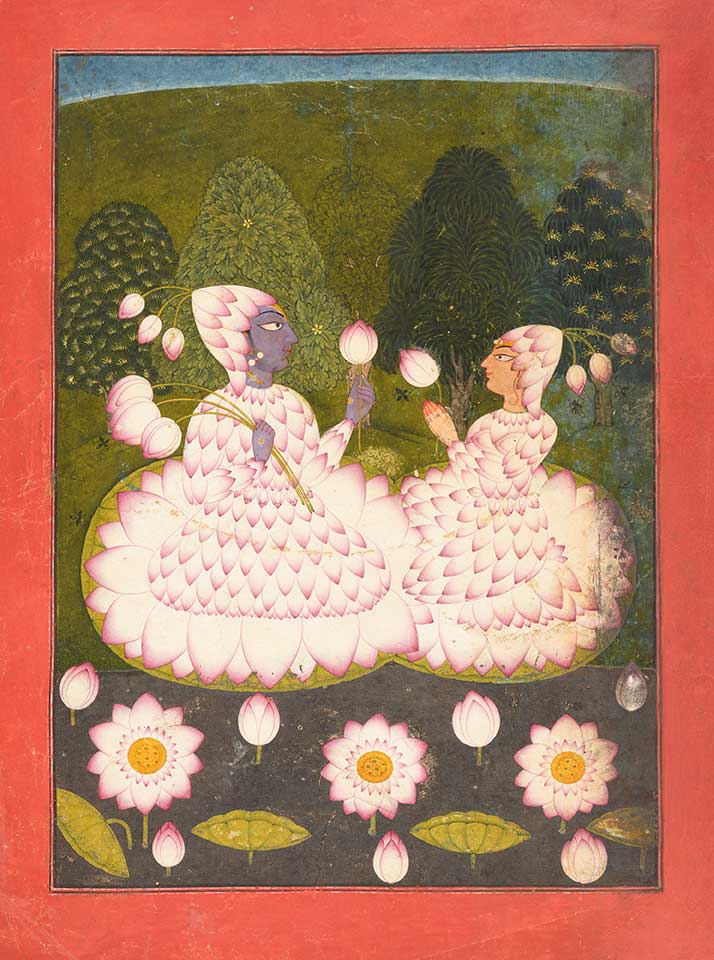
Krishna is another well-known avatar, who can take countless forms, recognisable as the dark-skinned (ghanashyam, dark as monsoon clouds), or as blue-skinned boy with a flute connected to Radha (a divine couple representing love), or as Govinda, the young boy portrayed with the gopis (cowgirls). However, artists from across South and Southeast Asia have portrayed Vishnu in many other styles and media. This exhibition features works from India and Cambodia, ranging from the 5th century to contemporary works created in 2026.
As the subject is complex, vast, and often confusing, and the scope of this exhibition is broad, this article focuses on just the better-known forms of Vishnu – as Rama and Krishna. Melanie Eastburn and Chaitanya Sambrani, co-curators of the exhibition, explain the breadth of the exhibition in related essays and in their introduction: ‘Our own contributions consider two strands within this broad historical framework. One examines how images and understandings of Vishnu have been shaped through the layering of new meanings and interpretive approaches onto older beliefs and practices (by Chaitanya Sambrani). The other considers the essential power of female presences in the manifestations of Vishnu and his avatars (by Melanie Eastburn)’.
In the catalogue, Caroline Widmer writes about ways in which artists have actively directed the creation of narrative images rather than simply illustrating scenes as described in well-known texts. She investigates paintings associated with Vishnu’s Rama and Krishna avatars through case studies from the Mughal and Bundelkhand workshops of the late 16th and early 17th centuries. These works are highlights of the exhibition and are some of the earliest paintings made to illustrate the Ramayana and Mahabharata. Made in 1594, during the reign of Mughal Emperor Akbar (1542-1605), they highlight the engagement of the Islamic Mughal court with Hindu literature and mythology. In her essay ‘Painting the Divine: Imagining Rama and Krishna through Diverse Sources’, she observes, ‘Paintings of Vishnu and his avatars have given visual form to sacred narratives for centuries’.
In South Asia in particular, images were often created for manuscripts, albums, or painted series, embedding them within rich literary traditions. These interpretations are diverse and versatile, with stories shared across multiple texts, languages, and narrative forms. Through adaptation and retelling, they have also changed over time and geography. This fluid textual landscape provides an essential context for understanding how painters engaged with their sources, not simply as illustrators of known texts, but as interpreters who selected, combined, and reimagined legendary tales.
Consensus identifies the Ramayana as being composed by the Indian sage Valmiki in the year 400, who based his epic work on stories, songs, and prayers connected to Rama and Sita. Rama, the seventh avatar of Vishnu, is primarily known as the embodiment of dharma and the ideal man (Maryada Purushottama). As the central figure of the Ramayana, he is renowned for upholding his duties as a son, husband, and king. Whilst the Ramayana’s origins are in Hinduism, it has since been retold in many different languages and art forms, and is celebrated in cultures across South and Southeast Asia. The epic tells the journey – both geographic and spiritual – of the dutiful Lord Rama, Prince of Ayodhya. Rama was exiled from his father’s kingdom for 14 years along with his wife Sita and his brother Lakshmana. His wife, the beloved Sita, is later abducted by Ravana, the demon king of the island of Lanka as an act of revenge, and imprisons her in his island kingdom. Rama then besieges Ravana’s fabled fortress, with the help of a monkey army (Vanara Sena) burns the capital city of Lankapura (believed to be in Sri Lanka) to rescue his wife. Through this ancient story, rooted in universal themes such as love, valour, duty, and human frailty, the Ramayana lives on in our present through illustrations and manuscripts, architecture, and the retelling of the tale through plays and puppet shows, especially in Indonesia, Thailand, and Cambodia.
In other art forms, Krishna features as a central guiding character and is the divine architect of events in the Mahabharata. This epic has been adapted many times into popular television series, comics, and films in India, as well as the more traditional theatre and dance forms found in Indonesia. Here, Lord Krishna is the central pivot of the Mahabharata and acts as the divine guide, strategist, and protector of the Pandavas. It chronicles a dynastic struggle between two groups of cousins for the throne of Hastinapura: the Pandavas (five virtuous brothers) and the Kauravas (100 ambitious brothers) in which he shifts the narrative from a mere familial power struggle to a profound battle for righteousness (dharma). The epic is considered the longest poem in the world with over 100,000 stanzas and is believed to have been written sometime in the 4th century BC. The earliest illustrated manuscripts that have survived date to the Mughal period in the 16th and 17th centuries, however, the epic was recorded earlier on reliefs and other stone works during the Khmer dynasty in Cambodia.
Various forms of Vishnu took a central place in the ancient Hindu kingdoms outside India, for example, they held a central place in the Khmer Empire (802-1431), particularly during the Angkorian period (9th–15th centuries), where the deity was venerated as a divine protector of the empire and its kings. Khmer art depicts Vishnu not only as a supreme deity but also through his various avatars, with a distinct emphasis on his role as the ‘preserver’. Seang Sokha’s contribution to the exhibition’s catalogue tells us that across the Khmer world, Vishnu was more than a guardian of cosmic order, he was also an element of political language and power allowing the Khmer kings to claim their sovereignty as ‘saviour-kings’. Sokha continues, ‘This capacity to embody both divine and worldly authority made Vishnu enduringly popular in ancient Cambodia. Because Vishnu is the god who descends when the world falters, he offered Khmer rulers a ready-made model of kingship – a theology of salvation translated into royal imagery. In Khmer art and inscriptions, the avatars of Vishnu became metaphors of rulership. From Varaha the boar lifting the earth to Vamana the dwarf measuring the worlds, each form mapped divine intervention onto royal power. This theology of descent evolved into a visual language of sovereignty across Khmer art and history’.
An insight into the role of Krishna during the Khmer Empire is offered by Thierry Zephir in his essay ‘Note on Representations of Krishna in the Angkorian Period’, who writes, ‘Although little precise epigraphic data can be decisively linked to the first developments of Krishna worship in Cambodia, notably in his appearance as the god lifting Mount Govardhan (govardhanadhara in Sanskrit), the very existence of the images at Phnom Da attests to the importance of Vaishnavism in the southern Khmer countries where pancharatra (or bhagavata) sectarian worship has been well documented since the 5th century. While developing conjointly with Shivaism and Mahayana Buddhism, Vaishnavism remained important in Cambodia until the end of the Angkorian era and even beyond, as seen in some sculptures that can be attributed to the 14th century or slightly later. All eras combined, Khmer art has bequeathed to us a great number of representations of Vishnu. In his most common depictions, the god is shown with four arms (caturbhuja in Sanskrit), holding his distinctive attributes in his hands: a conch shell (san ‘kha in Sanskrit), a mace (gada), a discus (cakra), and a small sphere representing the Earth (Bhumi), variously referred to as dharani or mahi in Cambodian epigraphy’.
Included in the exhibition, there is a Cambodian representation of Krishna, from the 6th century, holding up Mount Govardhana, as well as a recently restored 7th-century sculpture of a horse-headed avatar of Vishnu. Khmer bronzes, stone sculpture, and reliefs also depict Vishnu as a warrior riding his mount, Garuda, showcasing his martial prowess and role as a combatant against evil, known as Garuda-Vahana.
Alongside the historical representations of Vishnu, the exhibition presents modern interpretations in contemporary art from collections in Australia, India, Cambodia, Switzerland, and the UK. It also introduces new works created especially for the exhibition by artists Desmond Lazaro, Gitanjali Das, Kalam Patua, and Sumakshi Singh.
• 20 June to 5 October, Art Gallery of New South Wales, artgallery.nsw.gov.au


