

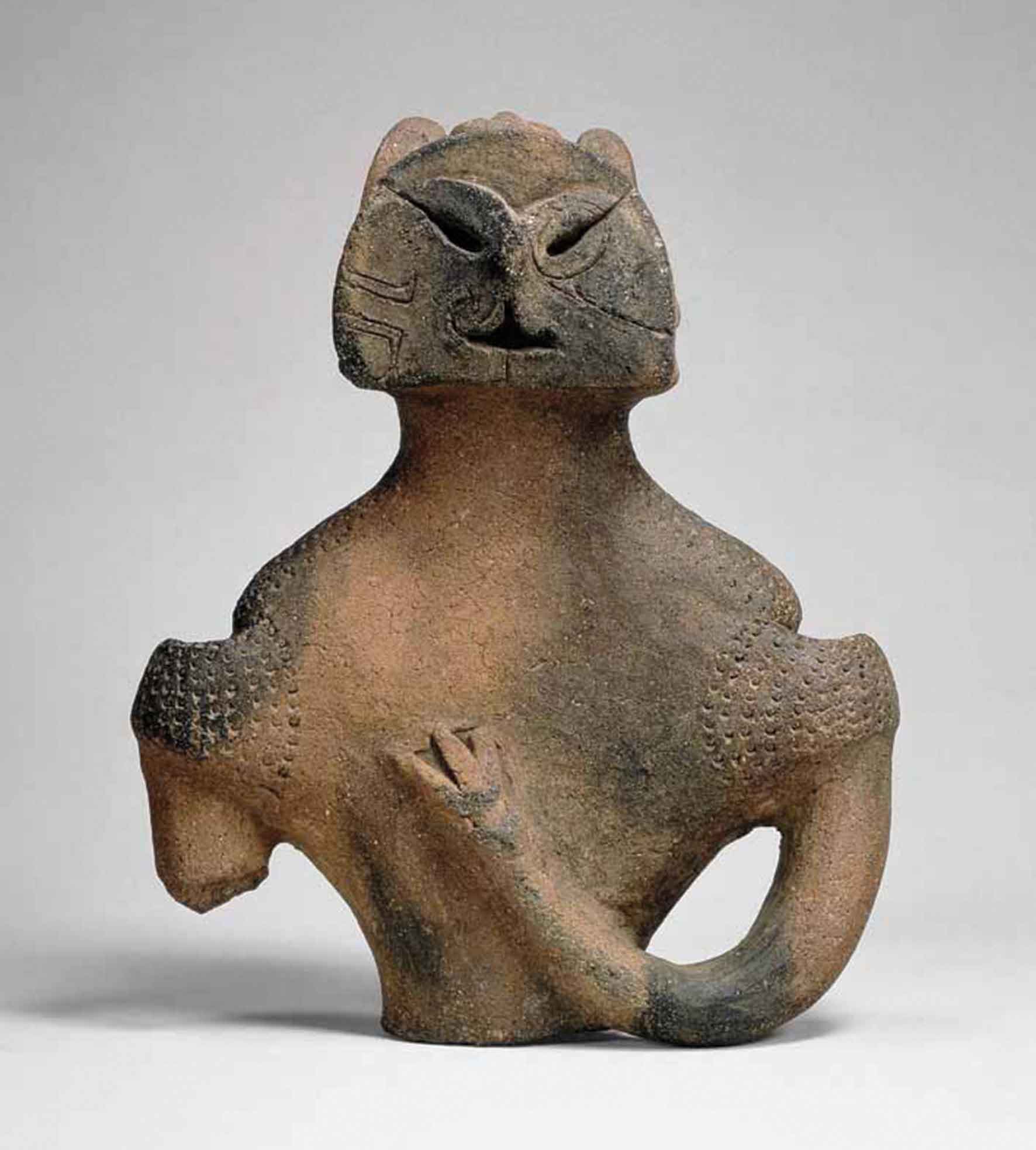
From the Jomon period of Japanese history, Dogu clay figures have fascinated the public, as seen in this exhibition, The Power of Dogu, held at the British Museum in 2009.
Dogu clay figures are abstract with recognisably human or animal features that have a fascinating history in Japan and date back thousands of years. These enigmatic figures have long captured the imagination of antiquarians, archaeologists and the public alike. They provide a tantalising link to the mysterious yet remarkable Jomon period (about 12,500-300 BC) of Japanese history. Dogu were hunter-gatherers and closely related with agriculture and developed as figures of an earth mother deity who was worshipped in prayer for rich harvests, production and fertility.
Jomon Period
These Japanese clay figures seem to have first appeared in the early days of the Jomon period (about 13,000 years ago) and developed most rapidly between the mid-Jomon period (3000-2000BC) and the final-phase Jomon period (1000-400 BC), during which many dogu with unique characteristics were created. Japanese dogu have distinct features which distinguish them from ancient European or West Asian ritual figures.
National Treasures of Japan
This 2009 exhibition featured 67 extraordinary objects, lent by many different public and private collections in Japan. Three of the exhibits were designated National Treasures of Japan by the government in 2009 and it was the first time the three National Treasures had been exhibited together: the Jomon Venus from Tanabatake (middle Jomon period, 3000-2000 BC), from Nagano prefecture, central Honshu; a dogu with palms pressed together (late Jomon period, 2000-1000 BC) from Aomori prefecture, Honshu; and a hollow dogu (late Jomon period, 2000-1000 BC), from Chobonaino site, Hokkaido.
An additional 25 examples that were included in the exhibition are ranked as Important Cultural Properties and Important Art Objects. It was the first time that such a wide range of the best existing examples of these early figures had been brought together in a single exhibition.
First Discoveries
Dogu were first discovered in the northern-most part of Honshu in the 17th century. While the Tokugawa shogunate was establishing itself in the earlier part of this century, strange objects were starting to be recovered and recorded at Kamegaoka, or the Hill of Jars, in the Tsuragu Peninsula; the objects came from the final Jomon period that is often called the Kamegaoka Culture.
A diary from northern Honshu, the Eiroku nikki (1623), describes the finding of a ceramic figure. Such finds were not unique, and the pace of discovery picked up during the latter part of the Edo period (1603-1868), when amateur antiquarians developed a passion for collecting these odd relics from an ancient past, which they usually considered remnants from the ‘Age of the Gods’ (a time that is considered to be the period between creation of the Japanese islands and the establishment of the rule of the mythological emperors). It was not until the end of the shogunate, and the restoration of imperial rule in 1868, that a new understanding of the archipelago’s ancient past began to develop.
The Jomon Culture
The clay figures evolved within the earliest dated continuous tradition of pottery manufacture in the world, stretching back to about 12,500 BC. They were produced by the Jomon culture, prehistoric foragers in the temperate forests that covered the Japanese archipelago. Research suggests that the people of the Jomon culture lived in tune with the seasons and shared their rich natural world with the spirits.
Since the Edo period (1615-1868), dogu have continued to be excavated from many sites throughout Japan, the best examples coming from central and north Honshu, from where most of the exhibits from this 2009 exhibition were drawn. More than 1,000 dogu have been recovered from each of two major sites, Shakado in Yamanashi prefecture and Sannai Maruyama in Aomori prefecture, however, these finds have been mostly in fragments. In 2009, the total number of known figures was about 18,000.
Decoration and Materials
Dogu are made from high-quality pottery and come in a variety of shapes often featuring intricate decoration and geometric designs. The techniques include modelling, clay appliqué, marking with twisted plant fibres (jomon means ‘cord-marked’) and burnishing. One of the largest complete figures in the exhibition, from Chobonaino, Hokkaido, is some 42 cm high. However, fragments have also been found of much larger examples that must originally have been over one metre in height; such an example is the Late Jomon-period head from the Shidanai site in Iwate prefecture, classified as an Important Cultural Property.
In addition to their often elaborate decoration, some dogu were painted – typically with red pigments – or covered in lacquer. They can take intriguing and attractive forms, with heart-shaped faces or triangular pointed heads. Some squat, perhaps in childbirth, others appear to be praying, still others apparently wear masks, such as the magnificent hollow-masked dogu discovered in 2000 in Nagano prefecture. Many of the figure have recognisably female characteristics, while others appear less gender-specific. All the figures may be hollow or made of solid clay.
There is much debate about what dogu meant to Jomon people and how they were used, particularly because many seem to have been deliberately broken before scattering or burial. In fact, they probably fulfilled a range of uses: as embodiments of spirits, venerated and revered; sometimes buried with the deceased to guide them to the next world; and most often fragmented during or after their use in Jomon rituals. Such rituals were perhaps intended to secure safe childbirth, or ensure a successful hunt.
Dogu as Artistic Inspiration
In the 20th century, dogu served as a potent source of artistic inspiration, and in recent decades they have even featured in manga comics and computer games. It is testimony to the power of these figures that they can serve, simultaneously, as symbols of prehistoric Japan, entrancing works of art, and protagonists in contemporary culture.
• The Power of Dogu: Ceramic Figures from Ancient Japan was at the British Museum in 2009 and travelled to Tokyo National Museum in 2010.
• Catalogue available


